A Guide to Neuromotor Exercise for Seniors
Ever feel a bit wobbly? Neuromotor exercise is all about sharpening the connection between your brain and your muscles. It helps with balance, coordination, and agility - the stuff that keeps you from tipping over when you trip on the cat. This guide breaks down what it is, why it matters, and some simple moves you can try today.
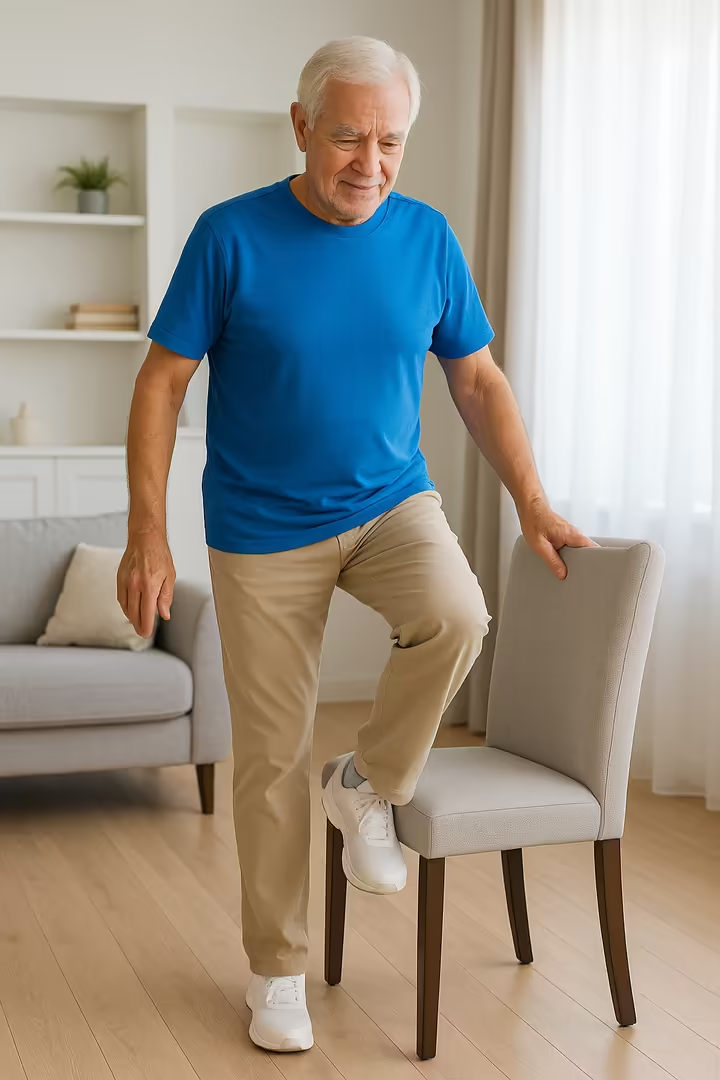
What is Neuromotor Exercise?
Neuromotor exercise gets your brain and muscles talking to each other better. It improves both muscle strength and the skill of your movements, making them more precise and efficient. It’s less about raw power and more about control. 1
Think of it like this: functional fitness helps you practice daily moves like squatting to pick something up. Neuromotor training gives you the balance and coordination to do those moves safely, without even thinking about it. 9
A big part of this is proprioception, your body's built-in GPS. It’s that sense that lets you touch your nose with your eyes closed. Neuromotor exercises sharpen this sense, which is key for staying balanced. 10
Why It's a Big Deal for Healthy Aging
So why do it? Because it helps you stay safe and independent. The biggest perk is preventing falls, which are a major risk for older adults. 14
Exercises like Tai Chi are great for this because they challenge your balance and coordination. Some studies show they can reduce recurring falls by a huge amount. 15 They retrain your body to catch itself when it starts to lose balance.
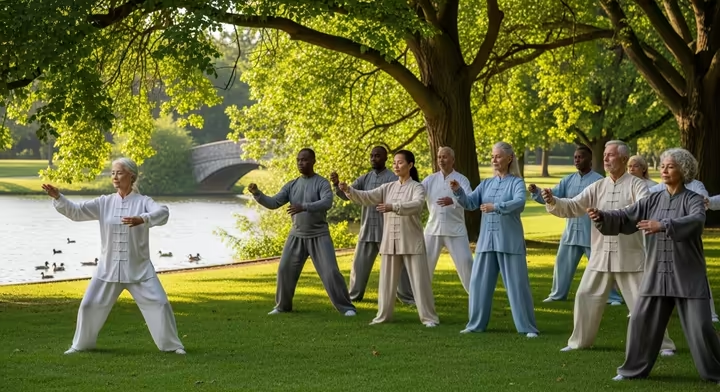
It also makes everyday stuff easier. Better stability makes it safer to walk on an uneven lawn, and better balance helps you step out of a car with confidence. 10 Agility - your ability to change direction quickly - is what helps you sidestep an obstacle. 18
And it’s good for your brain, too. Many of these exercises make you think and move at the same time, like following a dance sequence. This combo stimulates your brain, which can help improve memory, attention, and problem-solving skills. 19
The Building Blocks of Movement
Neuromotor training works because it targets a few key skills. The foundation is balance , which comes in two flavors. Static balance is staying still (like standing on one leg), while dynamic balance is staying steady while moving (like walking). 22
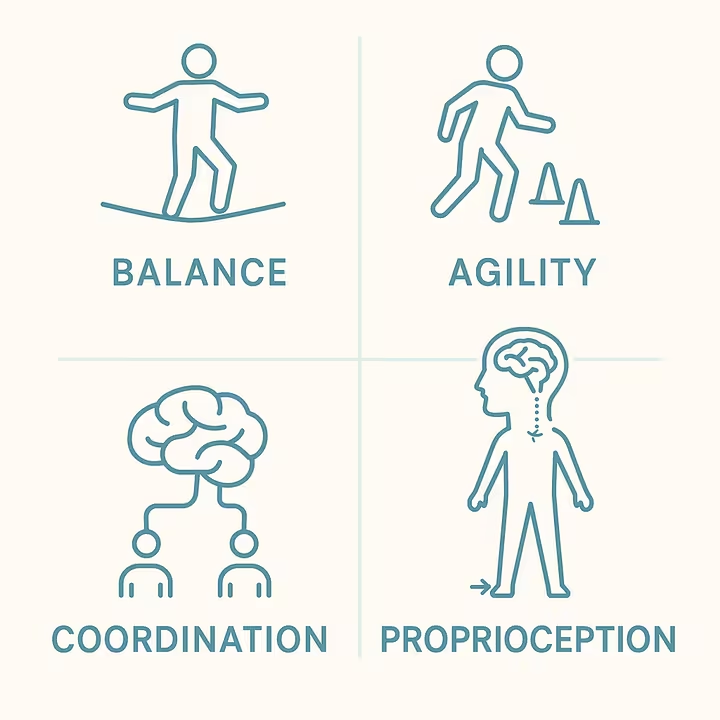
Agility is your ability to change direction quickly and with control. Think, dodging a rogue toddler or a runaway shopping cart. 24 It’s how your body adapts on the fly.
Coordination is how your brain gets different body parts to work together smoothly. It’s what you use to reach for something on a high shelf, using your core, legs, and arms all at once. 26
These skills all show up in your gait , which is just a fancy word for how you walk. A healthy gait is steady and adaptable, whether you're on carpet or a slippery kitchen floor. 13
Underpinning all this is proprioception , that "sixth sense" again. 10 It's the constant, unconscious feedback from your nerves that tells your brain where your body is. With age, this signal can get fuzzy, making you feel clumsy. Neuromotor exercises help clear up that signal so your brain gets timely, accurate info from your feet and ankles. 27
The Exercises: Let's Get Moving!
Here are some simple exercises to get you started. Make sure your area is clear, and always have a sturdy chair, counter, or wall nearby for support.
| Exercise Name | Main Skill Targeted | When You'd Use It |
|---|---|---|
| Single-Leg Stance | Static Balance, Proprioception | Staying steady while putting on pants or stepping into a tub. |
| Tandem Stance and Walk | Dynamic Balance, Gait | Walking down a narrow hallway or on an uneven path. |
| Clock Reach | Dynamic Balance, Coordination | Reaching for things without losing your balance. |
| Tai Chi: Parting the Wild Horse's Mane | Dynamic Balance, Coordination, Gait | Improving smooth movement for walking and turning. |
| Grapevine (Carioca) Steps | Agility, Coordination, Dynamic Balance | Moving sideways to get through a crowd. |
| Figure-8 Walking | Agility, Gait, Dynamic Balance | Navigating around furniture and other obstacles. |
| Standing Cross-Body Marches | Coordination, Dynamic Balance | Syncing up your arm and leg swing for a stable walk. |
| Simple Obstacle Course | All Skills | Putting it all together for navigating the real world. |
Exercises for Balance
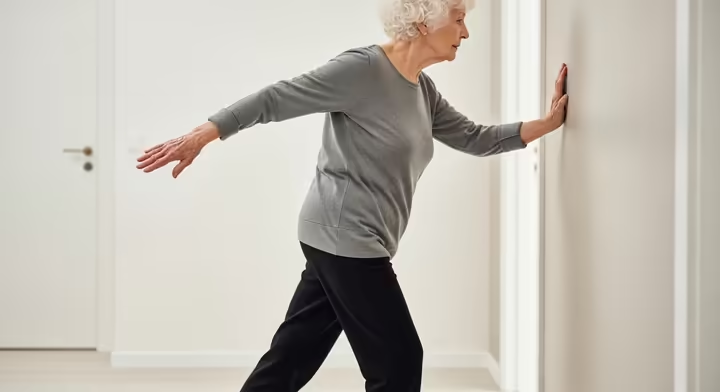
Single-Leg Stance
- What it's for: To get better at standing still on one leg (it's harder than it sounds!). This wakes up the little balance sensors in your ankle.
- Instructions:
- Stand tall behind a sturdy chair, holding on for support.
- Shift your weight to your left foot and bend the knee slightly.
- Slowly lift your right foot a few inches off the floor.
- Stare at a fixed spot in front of you - it helps!
- Hold for 10 seconds, working your way up to 30.
- Slowly lower your foot and switch sides.
- Safety first: Keep your supporting hand light on the chair. Use it for balance, not to hold your full weight.
- Make it easier: Just lift your heel, keeping your toes on the ground for a little extra support.
- Make it harder: Let go of the chair! For the ultimate challenge, try closing your eyes for a second (carefully!). 28
- Real-world use: Helps you stay steady when putting on pants or stepping over a puddle.
Tandem Stance and Walk
- What it's for: This heel-to-toe walk makes your balance better while you're moving.
- Instructions:
- Stand next to a wall, placing a hand on it for support.
- Place the heel of your right foot right in front of the toes of your left foot, like you're on a tightrope. Hold this stance for 10-20 seconds. 31
- To start walking, look ahead, not at your feet.
- Step forward with your left foot, placing its heel right in front of your right toes.
- Continue for 5-10 slow, careful steps.
- Turn around and walk back.
- Safety first: Always do this near a wall for support. It’s about control, not speed.
- Make it easier: Widen your stance a bit. Instead of heel-to-toe, try placing your heel next to the arch of your back foot. 22
- Make it harder: Use the wall less and less. For a real challenge, try walking backward heel-to-toe. 33
- Real-world use: Great for staying balanced in narrow spaces, like a grocery store aisle.
Clock Reach
- What it's for: Improves balance and coordination by making you reach outside your comfort zone while staying stable.
- Instructions:
- Stand on your left leg, holding a chair with your left hand. Imagine you're in the center of a clock on the floor. 12 is straight ahead.
- With your standing leg slightly bent, slowly lift your right arm and point to 12 o'clock.
- Move your arm to point to 3 o'clock.
- Carefully reach your arm behind you to point to 6 o'clock.
- Bring your arm back to 3, then to 12, before lowering it.
- Repeat 2-3 times, then switch legs. Now you'll be reaching to 12, 9, and 6 with your left arm. 29
- Safety first: Only reach as far as you can without losing your balance. Keep your hips facing forward.
- Make it easier: Keep both feet on the ground while doing the arm movements. Or, use your leg instead of your arm, tapping your toe to each "number." 36
- Make it harder: Do it without holding on. For an even bigger challenge, try it while standing on a foam pad.
- Real-world use: Mimics reaching into a cupboard or the back seat of a car.
Exercises for Agility and Coordination
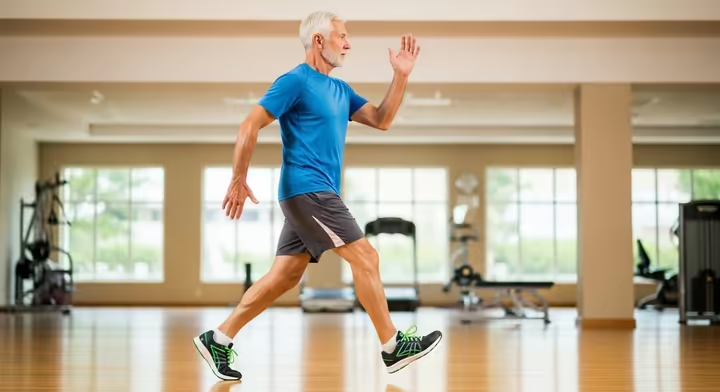
Tai Chi: Parting the Wild Horse's Mane
- What it's for: A classic Tai Chi move that blends balance, coordination, and gait training into one slow, graceful movement.
- Instructions:
- Stand with feet shoulder-width apart. Shift your weight to your right leg. Imagine holding a big ball on your right side (right hand on top, left hand under).
- Take a slow step forward and to the left with your left foot.
- As you step, shift your weight forward. Your arms "part" the ball, your left arm sweeping up to shoulder height while your right hand presses down. 37
- End with your weight on your front foot, looking in the direction of your left hand.
- To switch sides, shift your weight back, bring your left foot back, and "hold the ball" on your left side before stepping out with your right.
- Safety first: Keep your movements slow and fluid. Your knees should always be slightly bent.
- Make it easier: Practice just the arm movements while sitting in a chair. When standing, take smaller steps.
- Make it harder: Sink lower into your stance to challenge your leg strength and stability.
- Real-world use: The continuous weight shifting directly improves your stability while walking.
Grapevine (Carioca) Steps
- What it's for: Improves agility and your ability to move sideways.
- Instructions:
- Stand with your feet hip-width apart, with a clear path to your right.
- Step to the right with your right foot.
- Cross your left foot behind your right foot.
- Step to the right again with your right foot.
- Cross your left foot in front of your right foot.
- Continue this "side, behind, side, in front" pattern for several steps.
- Reverse the pattern to move back to the left. 39
- Safety first: Start very slowly to learn the pattern. Use a wall for light support if you need it.
- Make it easier: Do a simple side shuffle instead. Just step sideways with one foot, then bring the other foot to meet it. 41
- Make it harder: Pick up the pace a little bit and add a gentle arm swing.
- Real-world use: Helps you move confidently through a crowded room or step out of someone's way.
Figure-8 Walking
- What it's for: Challenges balance and agility by making you change directions constantly.
- Instructions:
- Place two small, safe objects (like pillows) on the floor about 4-6 feet apart.
- Start at one object and walk in a figure-8 pattern around both of them. 42
- Try to keep your steps smooth and your head up.
- Complete 3-5 figure-8s, then reverse direction.
- Safety first: Make sure your path is totally clear of other trip hazards.
- Make it easier: Place the objects farther apart to make the turns wider and less challenging.
- Make it harder: Increase your speed or place the objects closer together for tighter turns. 44
- Real-world use: This helps you navigate around furniture, people, and other obstacles with ease.
Standing Cross-Body Marches
- What it's for: Improves coordination between your upper and lower body while testing your balance.
- Instructions:
- Stand tall, holding a sturdy surface if needed.
- Keep your tummy muscles tight to stay stable.
- Slowly lift your right knee up toward your chest.
- As your knee comes up, bring your left hand across your body to tap it.
- Lower your leg and arm with control.
- Repeat on the other side, lifting your left knee and tapping with your right hand.
- Continue alternating for 10-15 reps per side. 30
- Safety first: The goal is control, not height. Don't lift your knee so high that you lean backward.
- Make it easier: Just march without the cross-body tap. Or, do the whole exercise while seated.
- Make it harder: Let go of your support. The slower you go, the harder it is for your balance.
- Real-world use: This reinforces the natural arm-and-leg swing you use when walking, which is key for a stable gait.
Simple Obstacle Course
- What it's for: To put all your skills together in a fun way that mimics real-world challenges.
- Instructions:
- Use safe household items to create a simple course.
- Station 1 (Agility): Place a few pillows on the floor. Zig-zag around them without touching them. 46
- Station 2 (Balance): Place a folded blanket on the floor. Step onto it and stand on one leg for 5-10 seconds on each side.
- Station 3 (Coordination): Put a laundry basket on the floor with rolled-up socks nearby. Stand on one leg (hold on if needed), pick up a pair of socks, and toss it into the basket. 46
- Station 4 (Gait): Use masking tape to make a straight line on the floor. Do the Heel-to-Toe Walk along the line.
- Safety first: Only use soft, stable objects that won't slip or trip you up. Make sure you have support available.
- Make it easier: Make the course simpler with fewer stations or easier tasks (e.g., walk over the pillows instead of around them).
- Make it harder: Add more complex tasks, like stepping over a shoe box or walking backward through part of the course. 47
- Real-world use: This is the ultimate functional exercise, training you to navigate the unpredictable world outside your door.
Getting Started Safely
Ready to start? Great. Just a few ground rules. The experts suggest aiming for 2-3 sessions a week, about 20-30 minutes each. 48 Mix these in with your other activities, like walking or stretching. 50
The main rule? Start slow. It’s better to do a move correctly and safely than to do it fast. Consistency is much more important than intensity.
Short, frequent sessions are better for retraining your brain than one long, tiring workout. This makes it easier to stick with it for the long haul.
And please, safety is everything. Check with your doctor or a physical therapist before you start. This is especially important if you have conditions like vertigo, severe osteoporosis, or anything else that affects your balance. 19
Optional Gear (But Not Required)
You don't need any equipment to start, but a few simple tools can add a new challenge. The goal of this gear isn't to add weight, but to challenge your balance in new ways.
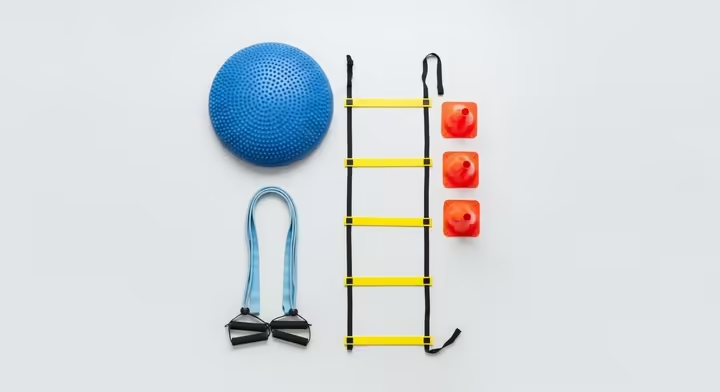
Foam pads or balance discs are great for this. Standing on a wobbly surface forces the tiny muscles in your feet and ankles to wake up and make constant adjustments to keep you upright. 53 This sharpens your balance reactions. 55
An agility ladder (which lies flat on the floor) or small cones can create patterns for you to follow. These drills improve coordination and speed by forcing you to place your feet accurately and change direction. 58
Light resistance bands can also be useful. Placing a band around your ankles during a side-step makes your hip muscles work harder to control the movement, improving your motor control. 59 Basically, this gear stops you from running on autopilot and forces your brain to pay attention.
The Fitness Dream Team
Think of your fitness like a team with four star players: cardiovascular exercise, strength training, flexibility, and neuromotor training. 48 They all have different jobs, but they work together to keep you healthy and independent.
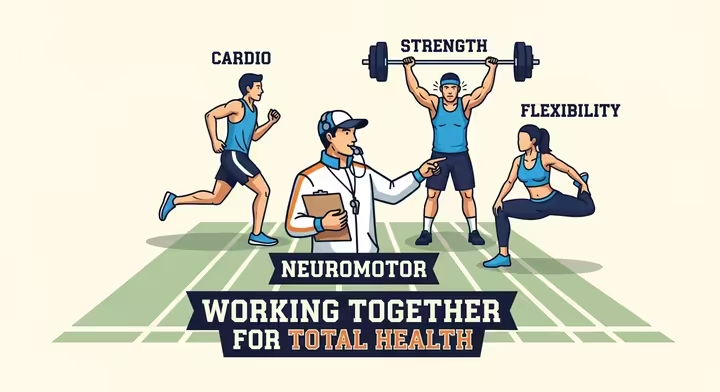
Strength training builds the muscle. 61 Cardio gives you the stamina. 62 Flexibility lets you move freely. 7 They build your body's potential .
Neuromotor training is the coach - it teaches all those parts how to use that potential together as a team. 1 It's what turns your physical fitness into real-world ability.
You can have strong legs from the gym, but still be at risk of falling if your brain can't apply that strength quickly to catch yourself after a trip. 13 Neuromotor training connects the dots. It bridges the gap between having strength and knowing how to use it to stay independent.
Works cited
- The Science of Balance: Neuromotor Training to Keep You Steady ..., https://leveragefitness.com/the-science-of-balance-neuromotor-training-to-keep-you-steady/
- Neuromotor Control: Definition & Techniques | Vaia, https://www.vaia.com/en-us/explanations/medicine/public-health/neuromotor-control/
- Peripheral Neuropathy: What It Is, Symptoms & Treatment - Cleveland Clinic, https://my.clevelandclinic.org/health/diseases/14737-peripheral-neuropathy
- Promoting Motor Function by Exercising the Brain - PMC - PubMed Central, https://pmc.ncbi.nlm.nih.gov/articles/PMC4061835/
- Motor Neurone - Physiopedia, https://www.physio-pedia.com/Motor_Neurone
- www.pacificneuroscienceinstitute.org, https://www.pacificneuroscienceinstitute.org/blog/brain-wellness-lifestyle/advantage-of-neuromotor-exercise-for-brain-body-health/#:~:text=Growing%20evidence%20from%20randomized%20controlled,mild%20cognitive%20impairment%20(MCI).
- Functional Fitness Training: Senior Edition - ISSA, https://www.issaonline.com/blog/post/functional-fitness-training-senior-edition
- Top 7 Functional Exercises for Older Adults - FOX Rehabilitation, https://foxrehab.org/functional-exercises-for-active-adults/
- Exercise: The Four Components & How to Accomplish Them, https://extension.sdstate.edu/exercise-four-components-how-accomplish-them
- What Are Neuromotor Exercises (With Examples) - Discover Walking, https://discoverwalking.com/what-are-neuromotor-exercises-with-examples
- Proprioception: A Primer on Balance & Aging | Lower Extremity ..., https://lermagazine.com/issues/september/proprioception-a-primer-on-balance-aging
- Proprioception/Balance & Aging - Fatch Fitness, https://fatchfitness.com/proprioception-balance-aging/
- Neuromotor Exercise for Gait Recovery | Just Walk Rehabilitation Device - Chaban Medical, https://www.chaban-medical.com/neuromotor-exercise-in-rehabilitation
- Taking balance training for older adults one step further: the ..., https://pmc.ncbi.nlm.nih.gov/articles/PMC4419050/
- Tai Chi for Arthritis for Fall Prevention - Tai Chi for Health Institute, https://taichiforhealthinstitute.org/programs/tai-chi-for-fall-prevention/
- www.oregon.gov, https://www.oregon.gov/oha/ph/preventionwellness/safeliving/fallprevention/pages/taichi.aspx#:~:text=Helping%20Older%20Adults%20Improve%20Their%20Balance%20and%20Reduce%20Falls&text=Research%20has%20shown%20that%20people,reduce%20the%20likelihood%20of%20falling.
- Proprioceptive and Strength Exercise Guidelines to Prevent Falls in the Elderly Related to Biomechanical Movement Characteristics - MDPI, https://www.mdpi.com/2227-9032/12/2/186
- Neuromotor Connection in Older Adults - NIFS Fitness Management, https://wellness.nifs.org/blog/neuromotor-connection-in-older-adults
- Neuromotor Exercise for Brain Health and Cognitive Function, https://www.pacificneuroscienceinstitute.org/blog/brain-wellness-lifestyle/advantage-of-neuromotor-exercise-for-brain-body-health/
- How Exercise Changes Your Brain for the Better - Peloton, https://www.onepeloton.com/en-AU/blog/exercise-and-the-brain
- The effect of physical exercise on the memory of elderly - an intervention study - SciELO, https://www.scielo.br/j/motriz/a/pRqQxXRR3cXp9GxYFkmCWSv/
- Static Balance vs. Dynamic Balance Exercises - Propel Physiotherapy, https://propelphysiotherapy.com/exercise/static-balance-vs-dynamic-balance-exercises/
- The Vital Role of Dynamic Balance in Promoting Safe Gait in the Elderly - GaitBetter, https://www.gaitbetter.com/dynamic-balance-elderly-gait-safety/
- Unlocking Agility: Surprising Benefits for Seniors - Wave Chiropractic, https://wavechiropracticfl.com/unlocking-agility-surprising-benefits-for-seniors/
- What is Agility? | American Sports & Fitness Association, https://www.americansportandfitness.com/blogs/fitness-blog/what-is-agility
- Unlocking Agility: Surprising Benefits for Seniors - Tri-States Chiropractic, https://dubuquechiropractic.com/unlocking-agility-surprising-benefits-for-seniors/
- Age-related changes in leg proprioception: implications for postural control, https://journals.physiology.org/doi/abs/10.1152/jn.00067.2019
- 15 Fun and Easy Balance Exercises for Seniors - Our Parents, https://www.ourparents.com/senior-health/15-balance-exercises-for-seniors
- 14 Chair Exercises for Seniors to Improve Strength and Balance ..., https://www.lifeline.ca/en/resources/14-exercises-for-seniors-to-improve-strength-and-balance/
- 22 of the Best Balance Exercises for Senior Citizens - Mobility Plus ..., https://www.mobilitypluscolorado.com/blog/22-of-the-best-balance-exercises-for-senior-citizens
- Tandem Stance - Ask Doctor Jo - YouTube, https://www.youtube.com/watch?v=ra7tzlPxnsQ&pp=0gcJCfwAo7VqN5tD
- BEST balance exercise for Seniors at HOME: Tandem standing ..., https://www.youtube.com/watch?v=uQkSmcDFRRM
- Seniors: Improve Balance with Heel to Toe Walking - YouTube, https://www.youtube.com/watch?v=n-f_dk7_WYg
- Physical or Occupational Therapy in Cleveland for Ankle Exercises - walking, https://www.therapy-specialists.com/Injuries-Conditions/Ankle/Exercises/Tandem-stance-while-walking/a~407/article.html
- www.lifeline.ca, https://www.lifeline.ca/en/resources/14-exercises-for-seniors-to-improve-strength-and-balance/#:~:text=Exercise%204%3A%20Clock%20Reach&text=Hold%20the%20chair%20with%20your,then%20to%20the%20number%2012.
- Clock Reach | Illinois Extension | UIUC, https://eat-move-save.extension.illinois.edu/move/exercise/clock-reach
- Part Wild Horse's Mane - MetroWest T'ai Chi, https://metrowesttaichi.com/wp-content/uploads/2015/03/2-Part-Wild-Horses-Mane.pdf
- 8 Forms Tai Chi, Form 3: Part the Wild Horse's Mane with Detailed Instructions in Back View, https://www.youtube.com/watch?v=mWctu-GQKwM
- Grapevine - Sworkit Health | On-Demand Fitness, Mindfulness, Recovery, and Nutrition, https://sworkit.com/exercise/grapevine
- Carioca - JEFIT, https://www.jefit.com/exercises/1421/carioca
- Coordination Exercises for Seniors - Healthline, https://www.healthline.com/health/medicare/coordination-exercises-for-seniors
- Figure 8 walking (Balance, walking forward, figure 8 pattern) (exercise video), https://us.physitrack.com/home-exercise-video/figure-8-walking
- Figure Eight Walking - YouTube, https://www.youtube.com/watch?v=EaWPPTgQB2M
- Exercises to Increase Agility: Figure 8s | Saint Luke's Health System, https://www.saintlukeskc.org/health-library/exercises-increase-agility-figure-8s
- Standing March | Physical Therapy Exercises - YouTube, https://www.youtube.com/watch?v=oeBQGTG-HME
- Obstacle Course for Gait, Balance & Coordination | OT & PT Balance ..., https://www.youtube.com/watch?v=boVMpZ6j3M0
- Agility & Balance Drills For Seniors For Preventing Falls - YouTube, https://www.youtube.com/watch?v=rYs26HEawno
- Coming of Age: Considerations in the Prescription of Exercise for Older Adults - PMC, https://pmc.ncbi.nlm.nih.gov/articles/PMC4969034/
- American College of Sports Medicine position stand. Quantity and ..., https://pubmed.ncbi.nlm.nih.gov/21694556/
- American College of Sports Medicine Updates Guidelines for Exercise Recommendations, https://www.sagchip.org/fitness/_newsletters/2011/acsmguidelines.pdf
- Functional and Neuromotor Performance in Older Adults | Request PDF - ResearchGate, https://www.researchgate.net/publication/7411847_Functional_and_Neuromotor_Performance_in_Older_Adults
- Principles of Exercise - Physiopedia, https://www.physio-pedia.com/Principles_of_Exercise
- Benefits of a Balance Disc for Improved Health, https://www.worldwideintegrative.com/the-benefits-of-a-balance-disc/
- Top 5 Foam Pad Exercises to Improve Balance and Reduce Dizziness, https://customcarerehab.com/blog/top-5-foam-pad-exercises-to-improve-balance-and-reduce-dizziness
- Foam pads properties and their effects on posturography in ..., https://pmc.ncbi.nlm.nih.gov/articles/PMC4308009/
- Effects of a balance training program using a foam rubber pad in community-based older adults: a randomized controlled trial - PubMed, https://pubmed.ncbi.nlm.nih.gov/24978931/
- Agility Ladder Exercises - OrthoBethesda, https://www.orthobethesda.com/physical-therapy/patient-education/agility-ladder-exercises/
- Agility Exercises: Our Favorite Drills to Try at Home - Healthline, https://www.healthline.com/health/fitness/agility-exercises
- The Best Exercise Equipment for Seniors (2025) - The Senior List, https://www.theseniorlist.com/exercise/best/
- The Best Exercise Equipment for Seniors of 2025, Tested - Verywell Fit, https://www.verywellfit.com/best-exercise-equipment-for-seniors-7563564
- Strength Training Equipment for Seniors: 7 Effective Options - TRUE Fitness, https://truefitness.com/strength-training-equipment-for-seniors-7-effective-options/
- Actively Aging: The Synergy of Adding Resistance Training to ..., https://resources.keiser.com/the-synergy-of-adding-resistance-training-to-cardio-exercise
- Neuromuscular Exercise Program NEMEX - Physiopedia, https://www.physio-pedia.com/Neuromuscular_Exercise_Program_NEMEX