Walking with Chondromalacia Patella: A Gentle Path Forward
So, your knee hurts. Specifically, the bit right under the kneecap. Doctors call it chondromalacia patella, which is a mouthful... but it basically means the cartilage is getting worn and cranky. It can make you wonder if walking is even a good idea. Spoiler alert: it is... if you do it right. This guide shows you how.
What's Happening in Your Knee?
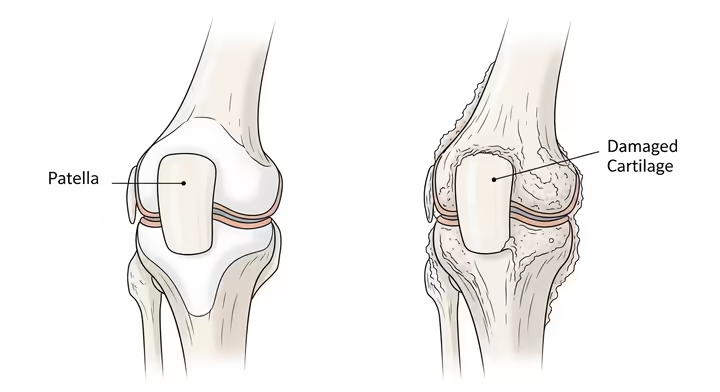
Chondromalacia patella is often called "runner's knee," but you don't have to be a runner to get it. 1 Think of the smooth cartilage under your kneecap getting rough, like sandpaper. That roughness causes a dull, aching pain when you do things like climb stairs or get up after sitting for a while. 3
How Walking Actually Helps
Your knee cartilage is like a sponge, it has no blood supply. It gets its nutrients from joint fluid being squeezed in and out. Gentle walking does exactly that, acting like a pump to feed the cartilage and keep it healthy. 7 Good walking also builds up the muscles around the knee, creating a natural brace that takes stress off the joint.
Surprise! It's Your Hips
Here's a secret, knee pain often starts with the hips. The muscles on the sides of your butt (your glutes) are supposed to keep your whole leg stable when you walk. 8
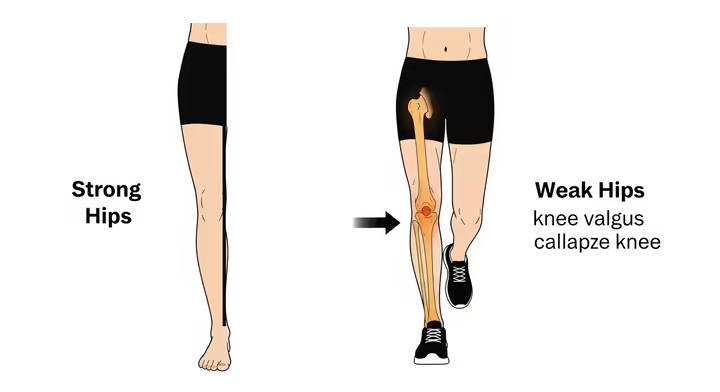
When those hip muscles are weak, your thigh bone drifts inward and your knee "caves in." 10 This yanks your kneecap sideways, causing it to grind where it shouldn't. 14 Basically, strong hips are the foundation of a happy knee.
When Walking Goes Wrong
Can walking make it worse? Yep, if you do it wrong. Walking with that same inward knee collapse, or stomping on hard surfaces, just reinforces the problem. 12 This creates a cycle of pain where the very thing that should help ends up hurting. The trick is to learn how to walk in a way that helps your knee, not hurts it.
How to Walk Right
You need to turn your walk from an accident into a skill. Your body might already be trying to protect itself by taking shorter steps. We're just going to make that a conscious habit.
Your Walking Checklist
- Posture Check: Stand tall, like a string is pulling the top of your head up. Gently pull your belly button toward your spine. This gives you a stable core to work from.
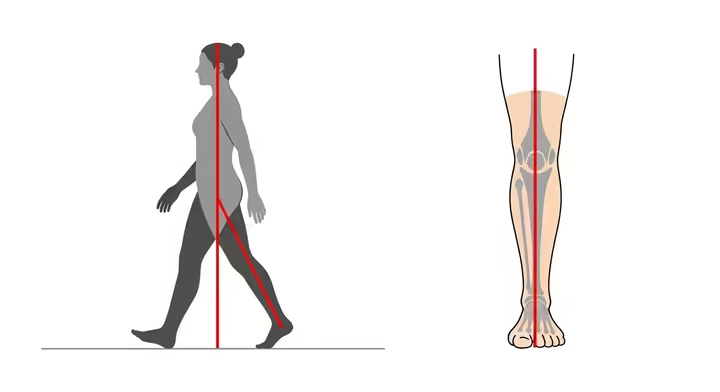
- Keep Knees Straight: This is the big one. As you walk, try to keep your kneecap pointing straight ahead, right over your second toe. 13 It might feel weird at first, but this keeps the kneecap gliding smoothly.
- Take More Steps (The Magic Bullet): Focus on taking shorter, quicker, lighter steps. A good trick is to pretend you're walking on hot coals. 18 This naturally shortens your stride and reduces the impact on your knee with every step.
- Walk Quietly: Try to walk so softly that someone next to you can't hear your footsteps. This forces you to land lighter, with your foot more underneath your body instead of way out in front. 21 No more heavy heel-striking!
Where You Walk Matters
Hard surfaces like concrete are tough on knees. 23 Whenever you can, choose softer ground. A rubber track, a dirt trail, or a flat grassy field are all great choices.
A treadmill is a fantastic starting point. It’s flat, cushioned, and predictable, so you can focus on your form without worrying about uneven ground. 24
The Hill Challenge
Going downhill is often the worst for knee pain. That's because your thigh muscles have to work like brakes, which squishes the kneecap against the thigh bone. 2 To make it easier, take tiny steps and zigzag down gentle slopes.
Uphill walking, on the other hand, can be great for strengthening your glutes and quads with less impact. 26 Just add hills in gradually, once you're comfortable on flat ground.
Getting Started (Without Overdoing It)
The key is to start low and go slow. This isn't a race. It's about building a good habit without causing a flare-up.
Phase 1: Getting Started
Don't worry about distance. Just aim for consistency and zero pain. Start with 10-15 minutes of walking, three days a week, on a flat surface like a treadmill. 28
Follow the one, most important rule: the "Pain-Free Rule." If you feel sharp or increasing joint pain, stop. If you're more sore hours after your walk than you were before, you did too much. It's not a failure, just feedback, rest and try a shorter walk next time. 12
Phase 2: Going a Little Farther
Once you can walk for 30 minutes, 3-5 times a week with no pain, you can start building endurance. Use the 10% rule , don't increase your total weekly walking time by more than 10% each week. 32
For example, if you walked 90 minutes this week (3 walks of 30 minutes), add just 9 minutes next week. That could be 3 walks of 33 minutes. This slow and steady approach is the best way to avoid injury. 34
It's Not Just About Walking
Walking is great, but it won't fix the root problem on its own. It works best as one part of a bigger plan. A strong knee needs a strong support system. 8
Exercises That Actually Fix the Problem
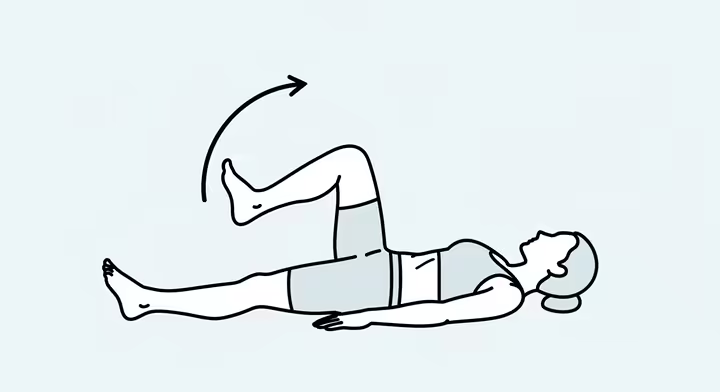
- Strengthening: You have to strengthen those weak hip muscles (glutes) and the small quad muscle on the inside of your knee (the VMO). 9 Simple exercises like clamshells, side-lying leg raises, and straight leg raises are perfect for this. 13
- Stretching: Tight muscles can also pull your kneecap out of line. Gently stretch your hamstrings, hip flexors, and quads to help restore balance. 38
Gear and Other Good Ideas
- Shoes: Good shoes are non-negotiable. Look for two things: great cushioning and good stability to keep your foot from rolling inward. 41 The best "walking shoes" are often just stable, well-cushioned running shoes from brands like HOKA, Brooks, or New Balance. They're built to handle way more force than walking, which is perfect for a sensitive knee. 17
- Trekking Poles: Poles are a huge help, especially on hills. They let your arms take some of the load off your legs, which means less stress on your knees. 23
- Weight Management: It's simple physics. Every extra pound of body weight adds four pounds of pressure to your knees when you walk. 7 Losing even a small amount of weight can make a massive difference.
Listen to Your Knee (It's Talking to You)
Think of your pain signals like a traffic light. This will help you decide what to do each day.
- Green Light: Mild muscle tiredness. This is good! Action: Keep going with your plan.
- Yellow Light: A dull ache that doesn't get worse and goes away with rest. Action: Be careful. Don't increase your walking time for a few days.
- Red Light: These are warning signs. Time to stop and get some advice.
Red Flag Symptoms
Stop walking and see a doctor or physical therapist if you have any of these:
- Sharp, stabbing, or bad pain.
- Swelling around the knee after you walk. 46
- The feeling that your knee is locking, catching, or giving way. 4
- Pain that keeps getting worse over a few days.
- Pain that wakes you up at night.
Seeing a professional isn't giving up, it's being smart. They can create a plan just for you, so you can keep moving safely for years to come.
Works cited
- Chondromalacia: Causes, Symptoms, and Diagnosis - Healthline, https://www.healthline.com/health/chondromalacia-patella
- The Runner's Guide to Chondromalacia - UOA - University Orthopaedic Associates, https://uoanj.com/the-runners-guide-to-chondromalacia/
- Chondromalacia - Cedars-Sinai, https://www.cedars-sinai.org/health-library/diseases-and-conditions/c/chondromalacia.html
- Patellofemoral Pain Syndrome - AAFP, https://www.aafp.org/pubs/afp/issues/2019/0115/p88.html
- Physical therapy in Congress Park, Denver Downtown, Central Park, and Highlands Area for Knee - Chondromalacia Patella, https://www.atlasptco.com/Injuries-Conditions/Knee/Knee-Issues/Chondromalacia-Patella-Patient-Guide/a~4869/article.html
- Chondromalacia Patella | Theorem Health, https://theoremhealth.co.uk/wp-content/uploads/Knee-Chondromalacia-Patella-min.pdf
- 8 Ways Exercise Helps Your Joints | Arthritis Foundation, https://www.arthritis.org/health-wellness/healthy-living/physical-activity/getting-started/8-ways-exercise-helps-joints
- Is Walking Actually Helpful To Heal Chondromalacia Patella? - YouTube, https://www.youtube.com/watch?v=OEJFfi1Wkhw
- More Than Just the VMO | Rehab for Anterior Knee Pain, https://www.toaeasttn.com/rehab-for-anterior-knee-pain-more-than-just-the-vmo/
- rehabilitation-protocol-for-patellofemoral-pain-syndrome.pdf, https://www.massgeneral.org/assets/MGH/pdf/orthopaedics/sports-medicine/physical-therapy/rehabilitation-protocol-for-patellofemoral-pain-syndrome.pdf
- Influence of the Hip on Patients With Patellofemoral Pain Syndrome: A Systematic Review, https://pmc.ncbi.nlm.nih.gov/articles/PMC3445210/
- Patellofemoral pain syndrome - Symptoms and causes - Mayo Clinic, https://www.mayoclinic.org/diseases-conditions/patellofemoral-pain-syndrome/symptoms-causes/syc-20350792
- Knees Caving In When Squatting/Jumping? Here's Your Fix for Knee Valgus, https://www.trifectatherapeutics.com/blog/knees-caving-in-when-squattingjumping-heres-your-fix-for-knee-valgus
- Patellofemoral Joint - Physiopedia, https://www.physio-pedia.com/Patellofemoral_Joint
- Causes and Treatments of Patellofemoral Dysfunction, http://www.aapsm.org/patellofemoral-dysfunction.html
- Vastus Medialis Oblique - Physiopedia, https://www.physio-pedia.com/Vastus_medialis_obliquus
- BIOMECHANICS AND PATHOMECHANICS OF THE ..., https://pmc.ncbi.nlm.nih.gov/articles/PMC5095937/
- The Effect of Patellofemoral Pain Syndrome on Gait Parameters: A ..., https://pmc.ncbi.nlm.nih.gov/articles/PMC5100443/
- How To Prevent Knee Valgus With Exercise - [P]rehab - Knee, https://theprehabguys.com/how-to-prevent-knee-valgus/
- How Increasing Your Running Cadence Can Protect Your Ankles, Knees, and Hips, https://www.theinjuryandperformanceclinic.co.uk/blog/how-increasing-your-running-cadence-can-protect-your-ankles-knees-and-hips
- Shock - Injury – Cadence – Quiet - Damien Howell PT, https://damienhowellpt.com/shock-injury-cadence-quiet/
- Running Technique to Help Avoid Knee Injury - Run and Become, https://www.runandbecome.com/running-training-advice/running-technique-help-avoid-knee-injury
- 5 Tips for Walking When You Have Sensitive Knees - Ozark Orthopaedics, https://ozarkorthopaedic.com/5-tips-for-walking-when-you-have-sensitive-knees/
- Treadmill vs Pavement: Which is Better for Knees | DC Physio, https://dcphysiotherapy.com.au/treadmill-vs-pavement-which-is-better-for-your-knees-when-running/
- How Running on the Treadmill affects Knee Health? - Young Bones Clinic, https://youngbonesclinic.com/how-running-on-the-treadmill-affects-knee-health/
- Hiking and Knee Pain: How to Find Relief | Bowen Hefley Orthopedics, https://www.drbillhefley.com/hiking-and-knee-pain-how-to-find-relief/
- Why do my knees hurt when I climb stairs? - Medical News Today, https://www.medicalnewstoday.com/articles/311263
- How to Start a Walking Program | Physical Therapy - US Rehabilitation and Health Services of Michigan, https://usptrehab.com/how-to-start-a-walking-program/
- Six-Week Beginner Walking Plan, https://www.bu.edu/fitrec/files/2020/03/AHA-walking-plan.pdf
- Start Your Own Walking Program for OA - WebMD, https://www.webmd.com/osteoarthritis/oa-start-walking-program
- Patellofemoral Pain Syndrome (PFPS): Symptoms & Treatment - Cleveland Clinic, https://my.clevelandclinic.org/health/diseases/17914-patellofemoral-pain-syndrome-pfps
- The 10% Rule of Running - STEPS Fitness, https://stepsfitness.com/the-10-rule-of-running/
- How Long Should You Walk or Run on a Treadmill to Lose Belly Fat? - Verywell Health, https://www.verywellhealth.com/how-long-should-a-treadmill-workout-be-8789715
- The 10% Rule: Does it hold True? | POGO Physio Gold Coast, https://www.pogophysio.com.au/blog/the-10-rule-does-it-hold-true/
- Is Walking Helpful to Heal Chondromalacia Patella, https://discoverwalking.com/is-walking-helpful-to-heal-chondromalacia-patella
- Top 5 Exercises for Chondromalacia Patellae - Surrey Physio, https://www.surreyphysio.co.uk/top-5/top-5-exercises-for-chondromalacia-patellae/
- VMO Strength Exercises - JOI Jacksonville Orthopaedic Institute, https://www.joionline.net/library/vmo-strength-exercises/
- Iliotibial Band Syndrome: Exercises - MyHealth Alberta, https://myhealth.alberta.ca/Health/aftercareinformation/pages/conditions.aspx?hwid=bo1580
- Tight hip flexors may be causing your knee pain | Nebraska ..., https://www.nebraskamed.com/health/conditions-and-services/orthopaedics/tight-hip-flexors-may-be-causing-your-knee-pain
- Can Tight Hamstrings Cause Knee Pain? - Hinge Health, https://www.hingehealth.com/resources/articles/tight-hamstring-knee-pain/
- 10 Best Shoes for Knee and Back Pain - Medical News Today, https://www.medicalnewstoday.com/articles/best-shoes-for-knee-and-back-pain
- The Best Shoes For Knee Pain | Arthritis Knee Pain Centers, https://arthritiskneepain.com/wellness-blog/the-best-shoes-for-knee-pain/
- How to Pick Walking Shoes When You Have Knee Pain - WebMD, https://www.webmd.com/osteoarthritis/features/choose-walking-shoe
- How to use trekking poles when hill walking - The British ..., https://www.thebmc.co.uk/en/hill-walking-trekking-poles
- Will losing weight help patellofemoral pain syndrome? - Davis and DeRosa Physical Therapy, https://www.davisandderosa.com/Injuries-Conditions/Knee/FAQs/Will-losing-weight-help-patellofemoral-pain-syndrome/a~3504/article.html
- Chondromalacia Patella: Symptoms, Diagnosis, Treatment | Pantai ..., https://www.pantai.com.my/medical-specialties/orthopaedic/chondromalacia