A Senior's Complete Guide to Using a Cane
So, you're thinking about using a cane. It can feel like a big step, maybe even a concession. But a cane is a powerful tool to keep you independent, safe, and doing the things you love. 1 Think of it as a trusty partner that helps you walk taller, farther, and with more confidence.

How a Cane Works
More Than Just a Stick
A cane helps your body in three ways, all at once. It gives you mechanical support, better stability, and extra sensory information. This combo is what makes it such a great mobility tool.
First, mechanical support. If you have a painful hip, knee, or ankle, a cane can take up to 25% of your body weight off that leg with every step. 1 This means less pressure on a sore joint, which leads to less pain and lets you walk longer. 6
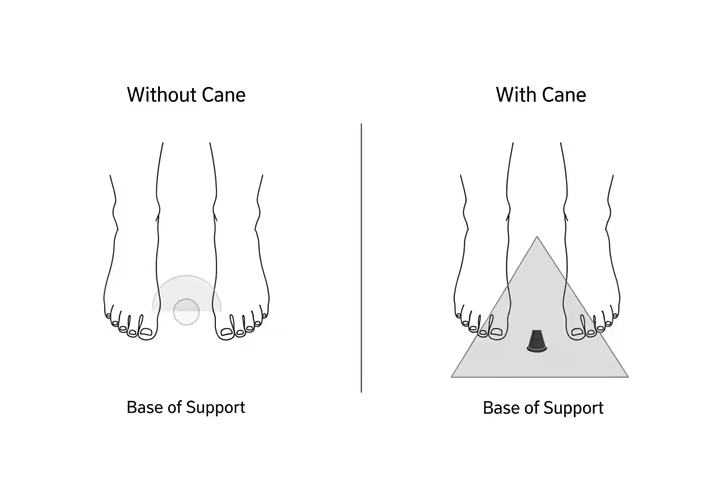
Second, stability. A cane gives you a wider base of support, like having a third leg. This makes you a much more stable tripod, so you're less likely to be knocked off balance by a crack in the sidewalk. 1 A fall is no joke, and a cane is a simple way to prevent one. 10
Third, sensory support. Your brain has a sense called proprioception, which tells it where your body is. A cane boosts this sense through haptic feedback, sending info from the ground up your arm to your brain. 4, 12 It's like a sensitive antenna, helping your brain make tiny adjustments to keep you balanced, which is especially helpful if you have neuropathy in your feet. 12, 13
Choosing Your Cane
Picking the right cane is key. It should feel like an extension of your body, not a clumsy accessory. The best choice matches the cane's features to your physical needs, so it's a good idea to chat with a doctor or physical therapist first. 14
Cane Types
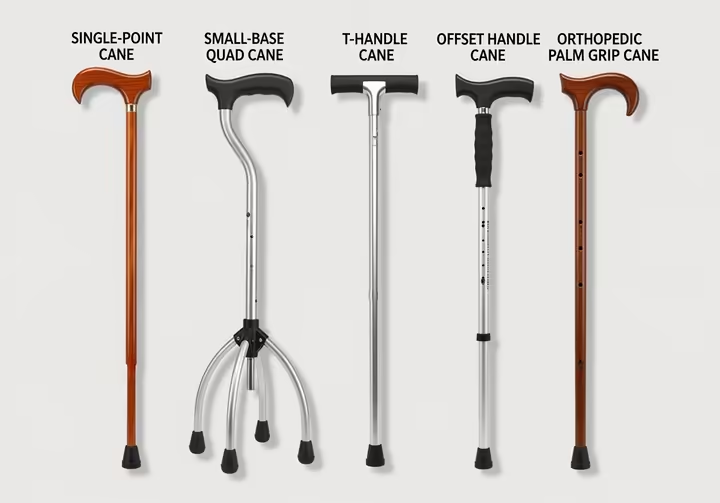
For a little extra stability or relief for a sore joint, the classic single-point cane is usually the best bet. 11 It’s the most common type, giving you one extra point of contact with the ground. 3
If you need more support because of major weakness or balance problems (maybe from a stroke), a quad cane is a better option. 4 This type has a base with four small feet, creating a wide platform that can stand on its own. 16 Large-base quads offer maximum stability but can be clunky, while small-base quads are a good compromise. 17
Materials and Handles
Wooden canes look classic and feel nice, but they usually aren't adjustable and can crack over time. 18 Aluminum canes are the modern standard because they're lightweight, strong, and almost always adjustable. 20
The handle is where you connect with the cane, so comfort is crucial. A T-handle (or Fritz handle) is good for arthritic hands because its flat shape avoids pressure points. 3 An offset handle, with its distinct bend, centers your weight over the cane's tip for better stability and less wrist stress. 3
For serious hand pain or weakness, an orthopedic (or palm grip) handle is the top choice. These are molded to fit your right or left hand perfectly, spreading pressure evenly across your palm for maximum comfort. 3
Getting the Right Fit
Sizing your cane is the most important step. A poorly sized cane can cause bad posture, new aches, and make you less stable. 26 Get this right, and the cane will reduce strain instead of creating it.
How to Measure
Use the "wrist crease method." Put on your walking shoes and stand up straight with your arms hanging at your sides. 29 Have a friend measure from the crease inside your wrist down to the floor. That measurement is your perfect cane height. 4
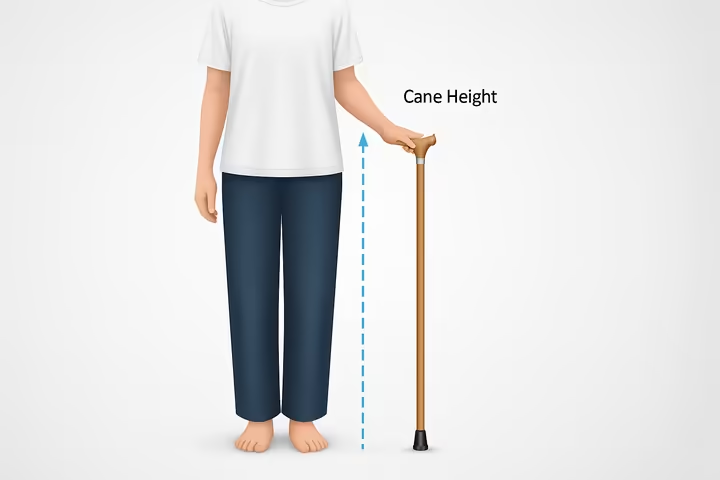
To double-check, hold the cane and look at your elbow. You should have a slight, comfortable bend of about 15 to 20 degrees. 4 This angle helps your arm absorb shock and push down without locking your elbow.
If a cane is too long, you'll hike your shoulder up, leading to neck and back pain. 5 If a cane is too short, it will cause you to hunch over and lean to one side, which ruins your posture and balance. 5
Which Hand Holds the Cane?
This one surprises people. The rule is simple: hold the cane in the hand opposite your weak or painful leg. 4 If your right knee hurts, the cane goes in your left hand. If your left hip is weak, it goes in your right hand.
This method mimics your natural walking rhythm, where your opposite arm and leg swing forward together. 8 Holding the cane in the opposite hand keeps your gait smooth and stable. It also creates a wider base of support, forming a stable tripod with your feet. 37
Most importantly, holding it on the opposite side is the best way to take pressure off the painful joint. It allows you to shift your center of gravity away from the sore spot, which can reduce the peak pressure on an affected hip by up to 60%. 38, 40 Holding it on the same side can actually make things worse.
Walking on Level Ground
Time to walk. Practice in a safe, clear space, like a hallway, until the rhythm feels automatic. The pattern is a simple three-beat sequence.
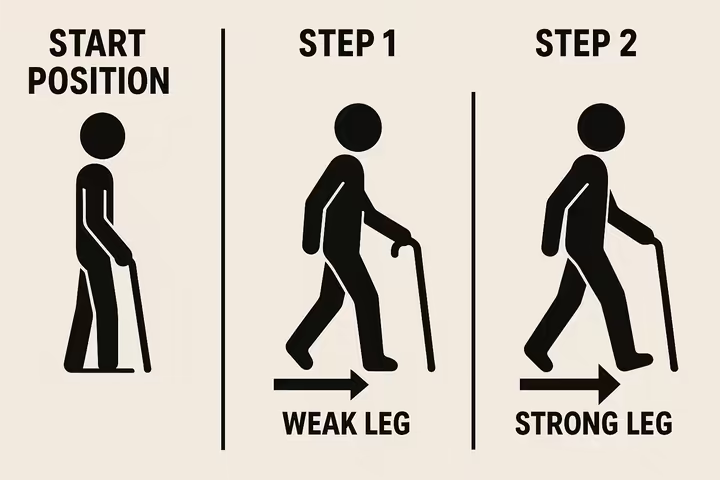
First, move the cane and your weaker leg forward together, about one step length. They should land on the ground at the same time. 8 Then, put your weight on both the cane and your affected foot. 3
Finally, step forward with your strong leg, moving it past the cane. That's one full cycle. The rhythm is: cane and weak leg, then strong leg. Stand tall and look ahead, not at your feet. 39
Help for Specific Conditions
A cane can adapt to help with different problems. For an arthritic knee, hip, or ankle, the cane's main job is to reduce damaging forces. Holding it on the opposite side helps counteract the knee adduction moment (KAM), a force that compresses the joint and causes pain. 6, 44 This gives immediate relief and may help slow joint damage. 7
If you're just feeling unsteady, the cane acts as a sensory tool. The feedback from the tip touching the ground gives your brain a third source of information, helping it make instant corrections to keep you from falling. 9, 48 The focus is on keeping the tip on the ground, not pushing down hard.
For back pain from conditions like spinal stenosis, a cane lets you lean forward slightly to relieve pressure on your nerves. 49 For one-sided back pain like sciatica, using the cane on the opposite side reduces stress transmitted up into your lower back. 50
Navigating Your World
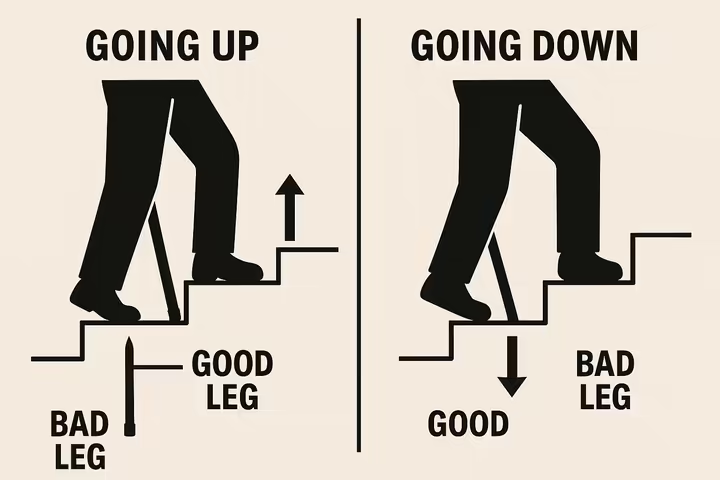
Life isn't flat. For stairs and curbs, remember this simple rule: "Up with the good, down with the bad." 28 It’s the key to handling changes in elevation safely.
Stairs and Curbs
Going up, you need power. If there's a handrail, use it. 53 Step up with your stronger ("good") leg first. Then, bring your weaker ("bad") leg and the cane up to meet it on the same step. 55
Going down, you need control. Hold the handrail. Place your cane and your weaker ("bad") leg down on the step below you first. Then, bring your stronger ("good") leg down to join them. 54
Curbs are just single stairs, so the same rule applies. 58 On tricky surfaces like ramps, grass, or gravel, take shorter steps. Make sure the cane tip is planted securely before you put your weight on it. 61
Staying Safe
Safe cane use is a partnership between you, your cane, and your environment. A little maintenance and awareness go a long way in preventing falls.
Cane Care and Common Mistakes
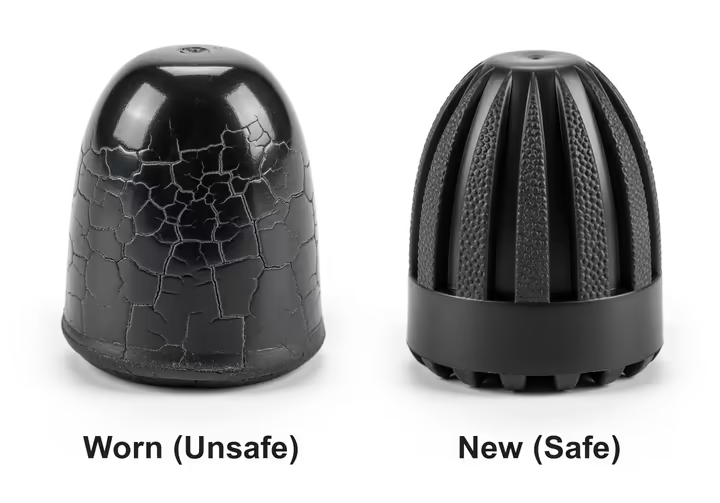
The rubber tip at the bottom is a critical safety feature, like the tread on a tire. 14 Over time, it wears down and becomes a slipping hazard. 28 Check it weekly, and if the tread is gone or the rubber is brittle, replace it. New tips are cheap and easy to find. 65
Avoid placing the cane too far in front of you, which can throw you off balance. 15 Also, don't lean your entire body weight on the cane. It's meant to assist you by supporting up to 25% of your weight, not replace your legs. 39
Finally, be aware of your surroundings. Get rid of tripping hazards like loose throw rugs, electrical cords, and clutter. 33 Clear, well-lit pathways are your best friend. 69 Taking control of your safety ensures your cane remains a reliable partner for an active life.
Works cited
- 8 Surprising Health Benefits of Using a Walking Cane (Beyond Just Support), https://www.canesgalore.com/blogs/news/the-surprising-health-benefits-of-using-a-walking-cane-more-than-just-support
- The Benefits of Walking Sticks for Seniors - St. Andrew's, https://standrews1.com/blog/the-benefits-of-walking-sticks-for-seniors/
- How To Use a Cane: Sizing, Safety, Training, Use & Stairs - Cleveland Clinic, https://my.clevelandclinic.org/health/procedures/how-to-use-a-cane
- Canes - Physiopedia, https://www.physio-pedia.com/Canes
- The effect of cane length and step height on muscle strength and body balance of elderly people in a stairway environment - PubMed Central, https://pmc.ncbi.nlm.nih.gov/articles/PMC4416409/
- Contralateral canes for knee osteoarthritis - Medwave, https://www.medwave.cl/puestadia/resepis/7759.html?lang=en
- Body weight support through a walking cane in inexperienced users with knee osteoarthritis, https://pubmed.ncbi.nlm.nih.gov/30286316/
- Using a Cane Properly - Ventura Orthopedics, https://venturaortho.com/using-a-cane-properly/
- Canes and Balance: The Ultimate Guide to Stability and Mobility, https://www.stickyourcane.com/blogs/articles/canes-and-balance-the-ultimate-guide-to-stability-and-mobility
- Effect of Different Types of Walking Aids on Gait and Balance in Patients with Stroke: A Review, https://www.ijhsr.org/IJHSR_Vol.13_Issue.11_Nov2023/IJHSR44.pdf
- Quad Cane Vs. Standard Cane: Which One Should You Choose? - Trualta, https://www.trualta.com/resources/blog/quad-cane-vs-standard-cane-which-one-should-you-choose/
- Haptic Cues for Balance: Use of a Cane Provides Immediate Body Stabilization - PMC, https://pmc.ncbi.nlm.nih.gov/articles/PMC5735113/
- Balance & Perception - Long Cane Training. - Jo Southall, Independent OT, https://jboccupationaltherapy.co.uk/balance-perception-long-cane-training/
- Tips for choosing and using canes - Mayo Clinic, https://www.mayoclinic.org/healthy-lifestyle/healthy-aging/in-depth/canes/art-20548206
- Tip Sheet: Choosing the Right Cane or Walker | HealthInAging.org, https://www.healthinaging.org/tools-and-tips/tip-sheet-choosing-right-cane-or-walker
- The Comprehensive Guide to Canes: Types, Tips & Style Explained, https://fashionablecanes.com/blogs/news/comprehensive-guide-canes
- Why You Should Look Into a Quad Cane Over a Single-Point Cane Now, https://www.warriorservicecompany.org/why-you-should-look-into-a-quad-cane-over-a-single-point-cane-now
- What Material is the Strongest for a Walking Cane, https://www.walking-canes.net/blogs/news/what-material-is-the-strongest-for-a-walking-cane
- How to choose the right material for your walking stick?, https://artwalkingsticks.com/blogs/blog/how-to-choose-the-right-material-for-your-walking-stick
- Walking Canes Buyers Guide: How to Choose the Right Cane? - Ergoactives, https://www.ergoactives.com/pages/walking-canes-buyers-guide
- Choosing the Right Cane: Material Type - Alex Orthopedic Inc., https://www.alexorthopedic.com/Choosing-the-Right-Cane-Material-Type_ep_49-1.html
- Choosing the Right Cane: Handle Style, https://www.alexorthopedic.com/Choosing-the-Right-Cane-Handle-Style_ep_51-1.html
- Canes & Accessories - Mobility - Products - Medline At Home, https://athome.medline.com/en/categories/mobility/canes-accessories
- How to Find the Best Cane for Your Needs | Performance Health, https://www.performancehealth.com/articles/how-to-find-the-best-cane-for-your-needs
- How to Choose the Right Type of Walking Cane Handle, https://fashionablecanes.com/pages/choosing-a-handle
- How To Measure and Size A Walking Cane Correctly | Aleks Physio - YouTube, https://www.youtube.com/watch?v=znGTJps2N_M
- Sizing, cutting & walking with a Cane, https://canescanada.com/Sizing-cutting-walking-with-a-Cane_ep_46-1.html
- Avoiding The Most Common Mistakes with Walking Canes: A Comprehensive Guide, https://www.chipperfieldphysio.ca/blog-1/avoiding-the-most-common-mistakes-with-walking-canes-a-comprehensive-guide
- fashionablecanes.com, https://fashionablecanes.com/pages/cane-sizing#:~:text=Have%20the%20user%20put%20on,upright%20as%20much%20as%20possible.&text=Using%20a%20tape%20measure%20or,to%20the%20nearest%20half%20inch.
- How to Measure and Use a Cane - Wood Chip Chatter, https://woodchipchatter.com/2023/09/01/how-to-measure-and-use-a-cane/
- Measure the Proper Height of your Walking Cane #cane #mobilityaid #elderlycare - YouTube, https://www.youtube.com/shorts/I95Mq8hinto
- How to Correctly Size a Cane - YouTube, https://www.youtube.com/watch?v=nzlgmby414A
- How To Use Crutches, Canes, and Walkers - OrthoInfo - AAOS, https://orthoinfo.aaos.org/en/recovery/how-to-use-crutches-canes-and-walkers/
- How Tall Should a Walking Stick Be? Height & Measurement Guide - Cool Crutches, https://www.coolcrutches.com/blogs/news/how-tall-should-a-walking-stick-be-the-ultimate-guide-to-choosing-the-perfect-walking-stick-for-comfort-support-and-style
- Lumex How to Use and Adjust your Cane - YouTube, https://www.youtube.com/watch?v=3CuUib39UL0&pp=0gcJCfwAo7VqN5tD
- In Which Hand Should You Hold Your Cane? - Verywell Health, https://www.verywellhealth.com/which-hand-should-i-hold-a-cane-in-2549334
- How to Choose the Right Cane - Arthritis Foundation, https://www.arthritis.org/health-wellness/healthy-living/managing-pain/joint-protection/how-to-choose-the-right-cane
- Why is my cane on the other hand? - Better With PT, https://betterwithpt.com/why-is-my-cane-on-the-other-hand/
- Effective Walking Techniques Using a Cane for Better Balance - Moovkart.com, https://www.moovkart.com/blogs/post/how-to-walk-with-a-cane-for-balance
- Effect of holding the cane (A) ipsilaterally or (B) contralaterally... - ResearchGate, https://www.researchgate.net/figure/Effect-of-holding-the-cane-A-ipsilaterally-or-B-contralaterally-with-respect-to-the_fig3_8090335
- How To Walk With Cane - YouTube, https://www.youtube.com/watch?v=tw6183_zXas
- HOW TO Walk with a CANE safely and easily | Fit, Use and More Tips - YouTube, https://www.youtube.com/watch?v=6377b2ZCr7I
- How to Walk with a Cane Safely & Comfortably - Because Market, https://becausemarket.com/blogs/news/how-to-walk-with-a-cane
- A Biomechanical Perspective on Physical Therapy Management of Knee Osteoarthritis - Braceworks Custom Orthotics, https://braceworks.ca/wp-content/uploads/2015/12/biomechanical-perspective-on-physical-therapy-management-of-knee-osteoarthritis-jospt.2013.4121.pdf
- A Biomechanical Perspective on Physical Therapy Management of Knee Osteoarthritis, https://www.jospt.org/doi/10.2519/jospt.2013.4121
- A smart cane with vibrotactile biofeedback improves cane loading for people with knee osteoarthritis - PubMed, https://pubmed.ncbi.nlm.nih.gov/28269026/
- Proper Ambulation with a Cane - Physiopedia, https://www.physio-pedia.com/Proper_Ambulation_with_a_Cane
- Effectiveness of Sensing and Feedback Alerting Smart Cane System: An Assisted Device for Geriatric Population to Prevent Falling, https://medicopublication.com/index.php/ijpot/article/download/19988/16926/41262
- How Walking Aids Can Help Spinal Stenosis Patients: Improve Mobility and Reduce Pain, https://painfreestart.com/how-walking-aids-can-help-spinal-stenosis-patients-improve-mobility-and-reduce-pain/
- Will a Cane or Walker Help with Back Pain? - Tulsa Pain Consultants, https://www.tulsapain.com/blog/will-cane-or-walker-help-back-pain/
- Best for Back Pain: Cane, Walker, or Something Surprisingly Different | Swift Health, https://www.swifthealthchiropractic.com/best-for-back-pain-cane-walker-or-something-surprisingly-different/
- www.arthritis.org, https://www.arthritis.org/health-wellness/healthy-living/managing-pain/joint-protection/how-to-safely-climb-stairs#:~:text=Going%20down%2C%20lead%20with%20the%20cane%2C%20followed%20by%20your%20weaker,%2C%20good%20leg%2C%20going%20down.
- How to Use Cane on Stairs - YouTube, https://www.youtube.com/watch?v=cRgWJTpOJds
- Safe stair climbing with a cane | Hamilton Health Sciences, https://www.hamiltonhealthsciences.ca/wp-content/uploads/2019/08/SafeStairClimbingCane-th.pdf
- How to Safely Climb Stairs - Arthritis Foundation, https://www.arthritis.org/health-wellness/healthy-living/managing-pain/joint-protection/how-to-safely-climb-stairs
- Using a Cane on Stairs - Ask Doctor Jo - YouTube, https://www.youtube.com/watch?v=xs9c5RPnjbk
- How to Go Up & Down Stairs with a Cane | Nursing Cane NCLEX - YouTube, https://www.youtube.com/watch?v=5hv6N6JCTPA
- Going up and down a curb using a cane - YouTube, https://www.youtube.com/watch?v=45oSDu_z1-w&pp=0gcJCfwAo7VqN5tD
- How to Step On and Off a Curb with a Cane - Omaha Physical Therapy Institute, https://omahapti.com/how-to-step-on-and-off-a-curb-with-a-cane/
- Using a Cane - Cigna Healthcare, https://www.cigna.com/knowledge-center/hw/using-a-cane-zt1156
- Mastering every terrain: how to use your walking cane on different surfaces, https://artwalkingsticks.com/en-gb/blogs/blog/mastering-every-terrain-how-to-use-your-walking-cane-on-different-surfaces
- Using a cane on uneven surfaces : r/Blind - Reddit, https://www.reddit.com/r/Blind/comments/pk18fo/using_a_cane_on_uneven_surfaces/
- How Different Surfaces Can Alter the Effectiveness of Canes, https://fashionablecanes.com/blogs/news/how-surfaces-can-alter
- Cane Tip Information - YouTube, https://www.youtube.com/watch?v=g6LFFt7pMvs
- Safety Tips for Using a Walking Cane - Fashionable Canes, https://fashionablecanes.com/blogs/news/safety-tips-for-using
- Avoid These 3 Common Cane Mistakes for Better Stability - TikTok, https://www.tiktok.com/@bobandbrad/video/7354741825699122475
- Preventing Falls | NIH News in Health, https://newsinhealth.nih.gov/2019/09/preventing-falls
- Preventing Falls: Moving Safely Using a Cane or Walker | Saint Luke's Health System, https://www.saintlukeskc.org/health-library/preventing-falls-moving-safely-using-cane-or-walker
- Preventing falls: MedlinePlus Medical Encyclopedia, https://medlineplus.gov/ency/patientinstructions/000052.htm