The Ultimate Guide to Choosing the Best Walking Stick for Seniors
Choosing to use a walking stick can feel like a big deal. But it's really just a smart way to stay safe and mobile. This guide breaks down everything you need to know, from the different types of sticks to getting the perfect fit.
Why Bother with a Walking Stick?
Deciding to use a walking stick can feel awkward. Some see it as just a symbol of getting older. In reality, it's a smart tool for staying mobile, safe, and independent. 1 A good stick helps turn the fear of falling into the freedom to take a longer, safer walk.

A walking stick gives you a third point of contact with the ground, which really helps with stability and balance. 3 It spreads your weight out, taking pressure off painful joints in your hips, knees, and back. 1 It also encourages better posture and can turn a simple walk into a full-body workout by engaging your arms and shoulders. 3
A big benefit is psychological, it helps break the "fear of falling" cycle. 7 After a fall, up to 73% of seniors develop this anxiety, causing them to stay home more often. 8, 10 Staying inactive makes muscles weaker and balance worse, which actually increases the risk of another fall. 8 A walking stick provides reliable support that boosts confidence and encourages you to stay active, helping you keep visiting family, shopping, and staying connected. 1, 2
Canes, Sticks, and Poles: What’s the Diff?
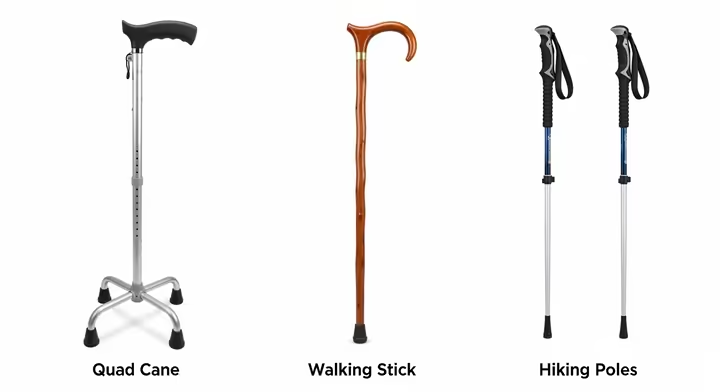
A walking cane is a medical tool. It's built for long-term use to support a good chunk of your body weight. 11 Doctors often recommend canes after an injury or for chronic conditions that cause pain or weakness in one leg. 13 Their handles are usually ergonomic to spread pressure across your palm and keep you stable. 4
A walking stick is for casual support, especially on uneven ground like a park trail or gravel path. 11 It's not meant to hold your full weight all the time. Think of it as a "third leg" to help you keep your footing. 12
Hiking poles are fitness tools that you always use in pairs. 14 Using two poles gives your upper body a workout and transfers up to 16% of the impact from your legs to your arms, which is great for your joints. 5 They aren't just for mountains, they're excellent for neighborhood walks, helping with rhythm, posture, and stability. 3
The Parts of a Walking Stick
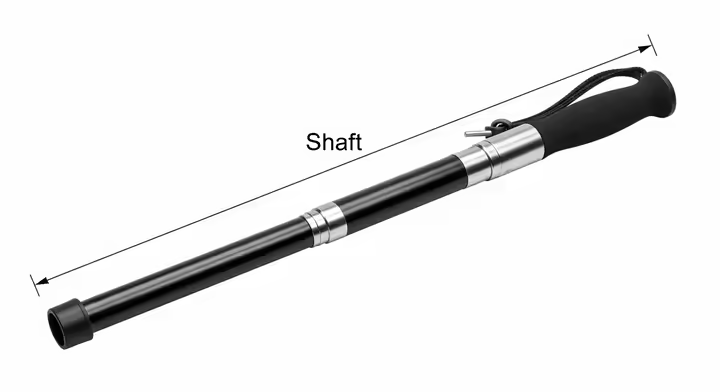
Grips and Handles
The handle is the most important part for comfort. T-shaped or Derby handles are common and work well for most people. 16 If you have arthritis, look for a Fritz handle, its open curve lets your fingers rest without cramping. 4 An offset handle has a bend that centers your weight over the stick's tip for better stability. 4
Grip material matters too. Cork is great because it absorbs sweat and molds to your hand over time. 19 Foam is softer and more cushioned, while rubber gives a firm, non-slip hold. 20
The Shaft: Aluminum vs. Carbon Fiber
The shaft is the stick's backbone. Aluminum is the standard, it's strong, light, and affordable. 23 Carbon fiber is the high-performance option, it’s even lighter and better at absorbing vibrations from the ground. 23 It's great for reducing arm fatigue and joint pain, but it costs more and can shatter from a sharp hit, whereas aluminum just bends. 20
Locking Mechanisms
For adjustable sticks, the lock is a key safety feature. External lever-locks (or flick-locks) use a simple clamp that's easy to open and close, even with weak hands or gloves. 26 Internal twist-locks require more grip strength to tighten and can sometimes slip or get stuck. 26
Tips (Ferrules)
The tip, or ferrule, is like the tire on a car. Most sticks have a rubber tip for good grip on most surfaces. 29 Check it often for wear, a smooth, bald tip is a serious slipping hazard and must be replaced. 21 For extra stability, a wide quad tip gives a larger base and lets the stick stand on its own. 12 In icy places, a retractable ice spike can be deployed for a secure grip on snow and ice. 32
Shock Absorption
Some sticks have a small internal spring that acts as a shock absorber. 35 It dampens the vibrations that travel up your arm with each step. This feature makes a big difference in comfort if you have arthritis or walk a lot on hard surfaces like concrete. 22
Choosing and Sizing Your Stick
First, think about where you'll use the stick most. For short trips around the house, a simple stick with a stable quad base might be perfect. For daily walks on sidewalks, a carbon fiber stick with shock absorption could be better to reduce joint impact. For longer walks on park trails, you might want a durable aluminum stick with an easy-to-use lever-lock.
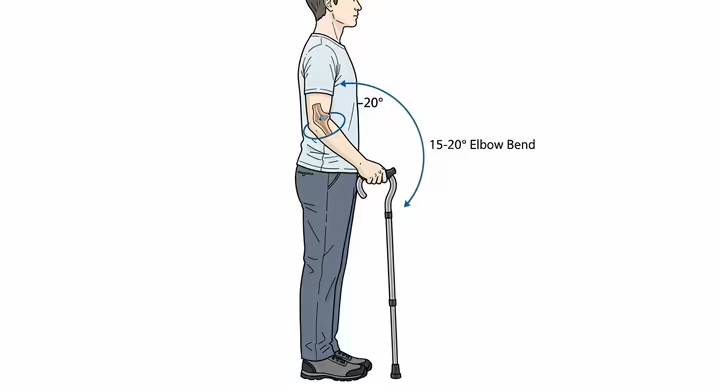
A stick that's too long will make you shrug, causing shoulder and neck pain. 38 A stick that's too short will make you hunch over, leading to back pain and an unsteady walk. 21 Remember to shorten your stick a bit when going uphill and lengthen it when going downhill, which is why adjustable sticks are the best choice for most people. 39
How to Use Your Walking Stick
Holding the Stick Correctly
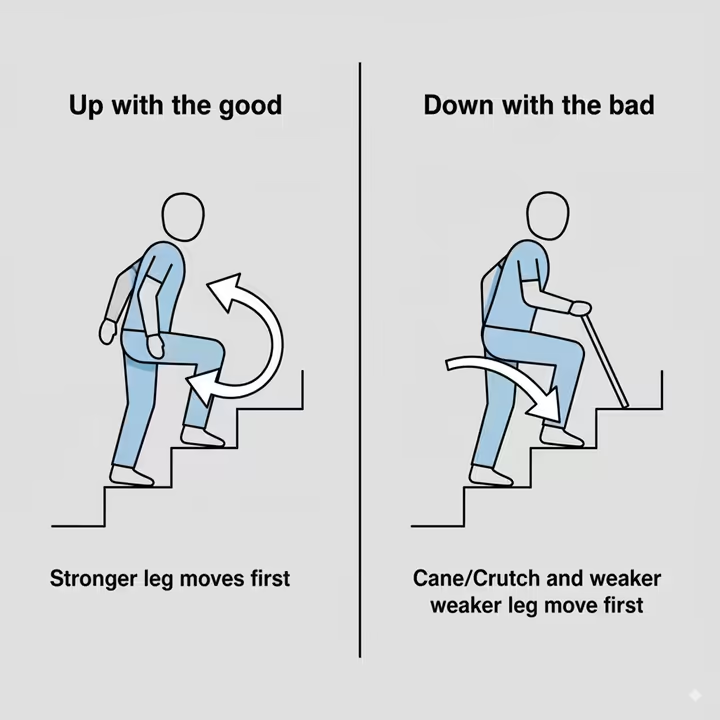
Tackling Stairs and Obstacles
Care and Maintenance
Look after your stick like any other piece of safety gear. Check the rubber tip often for cracks or wear, if the tread is gone, replace it immediately. 21, 30 Wipe the stick down with a damp cloth to keep it clean, paying attention to the grip and locking mechanisms. 30
Works cited
- Walking Sticks for Seniors: Boosting Mobility and Independence - AGEasy by Antara, https://ageasybyantara.com/senior-health/article/improving-mobility-and-independence-the-importance-of-walking-sticks-for-seniors
- Why Do Old People Need Walking Sticks? - JB Medical Equipment, https://jbmedical.com.au/why-do-old-people-need-walking-sticks/
- Walking Sticks: Are They Helpful? | The Jackson Clinics, https://thejacksonclinics.com/walking-sticks/
- Canes - Physiopedia, https://www.physio-pedia.com/Canes
- HOW WALKING POLES CAN HELP US AGE WELL, https://agewellproject.com/how-walking-poles-can-help-us-age-well/
- The benefits of walking sticks: how they can improve your health?, https://artwalkingsticks.com/blogs/blog/the-benefits-of-walking-sticks-how-they-can-improve-your-health
- Study: Fear of falling, fall-related injuries haunt full-time wheelchair, motorized scooter users, https://news.illinois.edu/study-fear-of-falling-fall-related-injuries-haunt-full-time-wheelchair-motorized-scooter-users/
- Fear of Falling - Physiopedia, https://www.physio-pedia.com/Fear_of_Falling
- How fear of falling can impact older adults' physical, mental health - Auburn University, https://wire.auburn.edu/content/ocm/2024/09/201104-fear-of-falling-ea.php
- How to Prevent Falls | Rehabilitation Research and Training Center on Aging With Physical Disabilities, https://agerrtc.washington.edu/info/factsheets/falls
- Cane Vs. Walking Stick: Which To Choose? | Caruth Haven Court, https://caruthhavencourt.com/dallas-tx-assisted-living-blog/cane-vs-walking-stick-which-to-choose/
- The Difference Between a Walking Stick and a Walking Cane - MedCart Australia, https://medcart.com.au/blog/the-difference-between-a-walking-stick-and-a-walking-cane/
- Walking Cane vs. Walking Stick - What's the difference? - Fashionable Canes, https://fashionablecanes.com/blogs/news/walking-cane-vs-stick
- Are there advantages to walking poles versus canes? - York Nordic, https://yorknordic.com/blogs/news/are-there-advantages-to-walking-poles-versus-canes
- Walking poles for seniors: how to choose the right ones, https://polewalkingaustralia.com.au/blog/walking-poles-for-seniors/
- The importance of grip and handle design in walking sticks, https://artwalkingsticks.com/blogs/blog/the-importance-of-grip-and-handle-design-in-walking-sticks
- Cane Handle Guide, https://canescanada.com/Cane-Handle-Guide_ep_45-1.html
- Fritz Handle | Ergonomic & Stylish Canes for Arthritis, https://fashionablecanes.com/collections/fritz-handled-canes
- The 10 Best Walking Sticks, Tested and Reviewed - Verywell Fit, https://www.verywellfit.com/best-walking-sticks-3435996
- A Guide To Walking Poles For Seniors - Physio Ed., https://physioed.com/health-advice/exercise-and-fitness/walking-poles-for-seniors/
- Tips for choosing and using canes - Mayo Clinic, https://www.mayoclinic.org/healthy-lifestyle/healthy-aging/in-depth/canes/art-20548206
- WALKING POLES FOR SENIORS | TSL Outdoor US, https://www.tsloutdoor.com/walking-poles-seniors
- Choosing Trekking Poles: Aluminum or Carbon Fiber – Cascade ..., https://cascademountaintech.com/blogs/news/which-is-better-aluminum-or-carbon-fiber-trekking-poles
- Choosing the Best Walking Cane - Vive Health, https://www.vivehealth.com/blogs/resources/best-walking-canes
- Choosing Trekking Poles: Which is Better Aluminum or Carbon Fiber, https://www.hikerhunger.com/blogs/news/choosing-trekking-poles-which-is-better-aluminum-or-carbon-fiber
- A Quick Overview About Trekking Poles Design - Cnoc Outdoors, https://cnocoutdoors.com/blogs/blog/a-quick-overview-about-trekking-poles-design
- How to Choose Trekking Poles - Treeline Review, https://www.treelinereview.com/howtochoose/trekking-poles
- What are the advantages of different locks for collapsible trekking poles?, https://outdoors.stackexchange.com/questions/13753/what-are-the-advantages-of-different-locks-for-collapsible-trekking-poles
- The Anatomy of a Walking Cane, https://fashionablecanes.com/blogs/news/the-anatomy-of-a-walking
- How to properly care for your walking stick? Cleaning and ..., https://artwalkingsticks.com/blogs/blog/how-to-properly-care-for-your-walking-stick-cleaning-and-maintenance-tips
- www.mayoclinic.org, https://www.mayoclinic.org/healthy-lifestyle/healthy-aging/in-depth/canes/art-20548206#:~:text=Most%20people%20do%20well%20with,are%20recovering%20from%20a%20stroke.
- Supportive Walking Cane Bases & Large Tips - Fashionable Canes, https://fashionablecanes.com/collections/supportive-bases-and-large-tips
- AmbuTech Support Cane Flip-up Ice Spike - The Carroll Center for the Blind, https://carroll.org/product/ambutech-support-cane-flip-up-ice-spike/
- Retractable Ice and Snow Spike Tip for Canes and Crutches :: Medium - The Wright Stuff, https://www.thewrightstuff.com/ingrid-retractable-ice-spike-tip-medium.html
- Hiking Stick Shock Absorber Walking Sticks For Arthritis | Stick & Cane Shop Hiking Poles Collapsible Lightweight, https://www.jokersclays.com/194262/For-Arthritis-Stick-Cane-Shop
- Urban Poling Activator® Poles - Arthritis Foundation, https://www.arthritis.org/partnership/ease-of-use-products/urban-poling-activator-poles
- Advantages and Disadvantages of Using Hiking Sticks in the Mountains - UIAA, https://www.theuiaa.org/advantages-and-disadvantages-of-using-hiking-sticks-in-the-mountains/
- Sizing, cutting & walking with a Cane, https://canescanada.com/Sizing-cutting-walking-with-a-Cane_ep_46-1.html
- Choosing the right height for your walking stick, https://artwalkingsticks.com/blogs/blog/choosing-the-right-height-for-your-walking-stick
- How to Size & Measure a Walking Cane | Fashionable Canes, https://fashionablecanes.com/pages/cane-sizing
- How to Use a Cane: Tips for Seniors to Maintain Balance and ..., https://californiamobility.com/how-to-use-a-cane/
- How to use walking sticks for seniors?, https://artwalkingsticks.com/blogs/blog/how-to-use-walking-sticks-for-seniors
- Assistive cane - Wikipedia, https://en.wikipedia.org/wiki/Assistive_cane
- How to Use a Walking Stick/Cane Correctly - YouTube, https://m.youtube.com/watch?v=Ry9kwq4HwTg
- Walking Sticks: Finding Balance and Support on Uneven Terrain - Medpoint, https://medpoint.ie/walking-sticks-finding-balance-and-support-on-uneven-terrain/
- How to Care for Your Walking Cane: Style, Maintenance, and Longevity, https://www.canesgalore.com/blogs/news/how-to-care-for-a-walking-cane